Electric outboard motor buying guide for European boaters (2026)
Power equivalence, battery sizing, real-world range and what electric propulsion actually costs over five seasons in European waters.
14 July 20269 min readBy Burin Boats technical desk
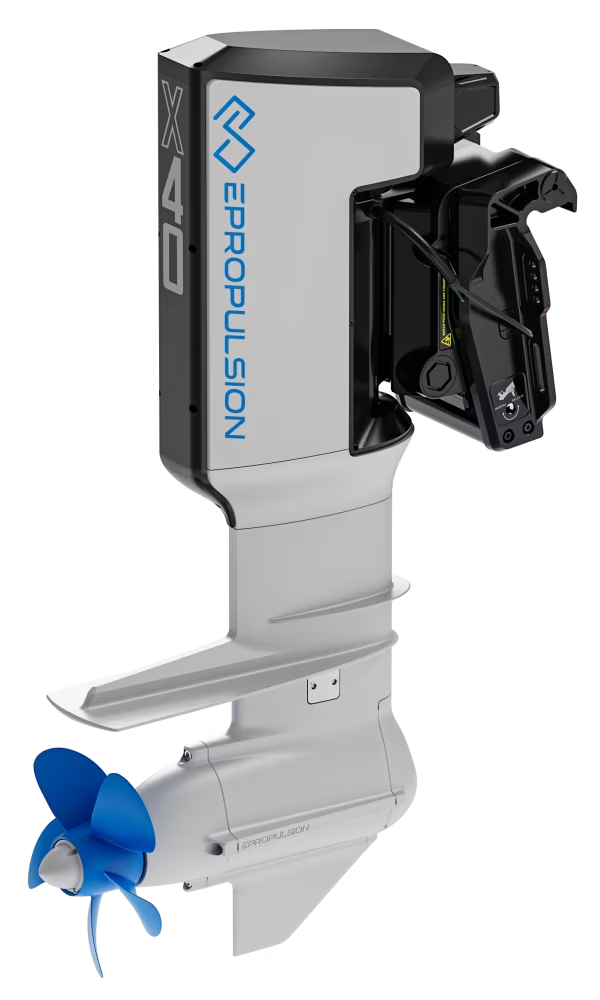
Electric outboards have moved from a curiosity to the default choice on tenders, lake boats and day cruisers across Europe. Emission-free zones on Alpine and Italian lakes, quiet-hours rules in Croatian bays and rising fuel prices all push in the same direction. This guide explains how to size an electric drive correctly the first time.
Start with thrust, not horsepower
Electric motors are usually quoted in kilowatts of input power, and a good rule of thumb is that 1 kW of electric input performs like roughly 1.3–1.5 hp of petrol thanks to higher propeller efficiency and instant torque. A 3 kW electric drive therefore replaces a typical 5 hp petrol outboard on a tender or small RIB.
The important number is the load you actually push: hull length, displacement, the number of people on board and whether you plan to plane or cruise at displacement speed.
- Tenders and dinghies up to 3.5 m: 1–3 kW
- RIBs and small day boats 3.5–5 m: 3–6 kW
- Sailing yachts up to 10 m (auxiliary): 6–10 kW
- Planing RIBs and larger day boats: 10 kW and above
Battery capacity is what decides your day
Range is simply usable battery energy divided by the power you draw. A 2 kWh battery driving a motor at 1 kW gives roughly two hours of cruising; the same battery at full 3 kW output gives about forty minutes.
Most owners cruise at 40–60% of rated power, which is where electric drives are dramatically more efficient than petrol. Plan your capacity around cruising, then keep a 20% reserve for wind, current and the trip home.
Charging in practice
Marina shore power in the EU is typically 230 V / 16 A, which comfortably supports a standard charger overnight. Fast chargers cut a full cycle to a few hours where the battery chemistry allows it.
Solar trickle charging is genuinely useful on moorings: 100–200 W of panel can replace a short daily commute across a bay over the course of a week.
Cost of ownership over five seasons
Electric drives cost more to buy and far less to run. There are no oil changes, no impeller or spark plug service intervals, no winter fuel stabiliser and no carburettor problems after storage. Energy for a full season of tender use typically costs less than a couple of tanks of petrol.
Batteries are the consumable. Quality lithium packs are rated for thousands of cycles and are typically covered by a multi-year warranty, so budget for replacement well beyond the first decade of light use.
Regulations you should check before buying
Several European inland waters restrict or ban combustion engines — parts of the Italian and Austrian lakes, Slovenian rivers and many nature reserves in Croatia and Germany. Electric propulsion is often the only legal option there, and sometimes the only way to obtain a mooring.
Registration and licence thresholds vary by country and are usually tied to power output, so confirm the local kW limit before ordering.
Frequently asked questions
- How long does an electric outboard battery last on one charge?
- Between roughly 45 minutes at full power and 5–8 hours at slow cruising speed, depending on battery capacity. Sizing the battery for cruising power rather than maximum power is the key to a usable day on the water.
- Can I use an electric outboard in salt water?
- Yes. Modern electric outboards are built for marine use with sealed, corrosion-resistant components. Rinse with fresh water after use, exactly as you would with a petrol outboard.
- What power do I need to replace a 5 hp petrol outboard?
- A 3 kW electric outboard is the usual equivalent of a 5 hp petrol engine for tenders and small RIBs, with better low-speed handling thanks to instant torque.
About the author
Burin Boats technical deskRigging, commissioning and after-sales
Our technicians rig, commission and service the boats and electric drives we deliver. They write the propulsion and maintenance guides in this journal from the jobs on their own workbenches — sizing motors, wiring battery banks and preparing boats for lay-up and launch.
Need advice for your own boat?
Our team configures Highfield, Beneteau and ePropulsion packages every week — tell us how you use the boat and we will size it properly.